
Published on May 15, 2026
From Prompt to Production System
The future of AI video production is not just prompting. It is building structured production systems that turn strategy and creative direction into scalable video output.
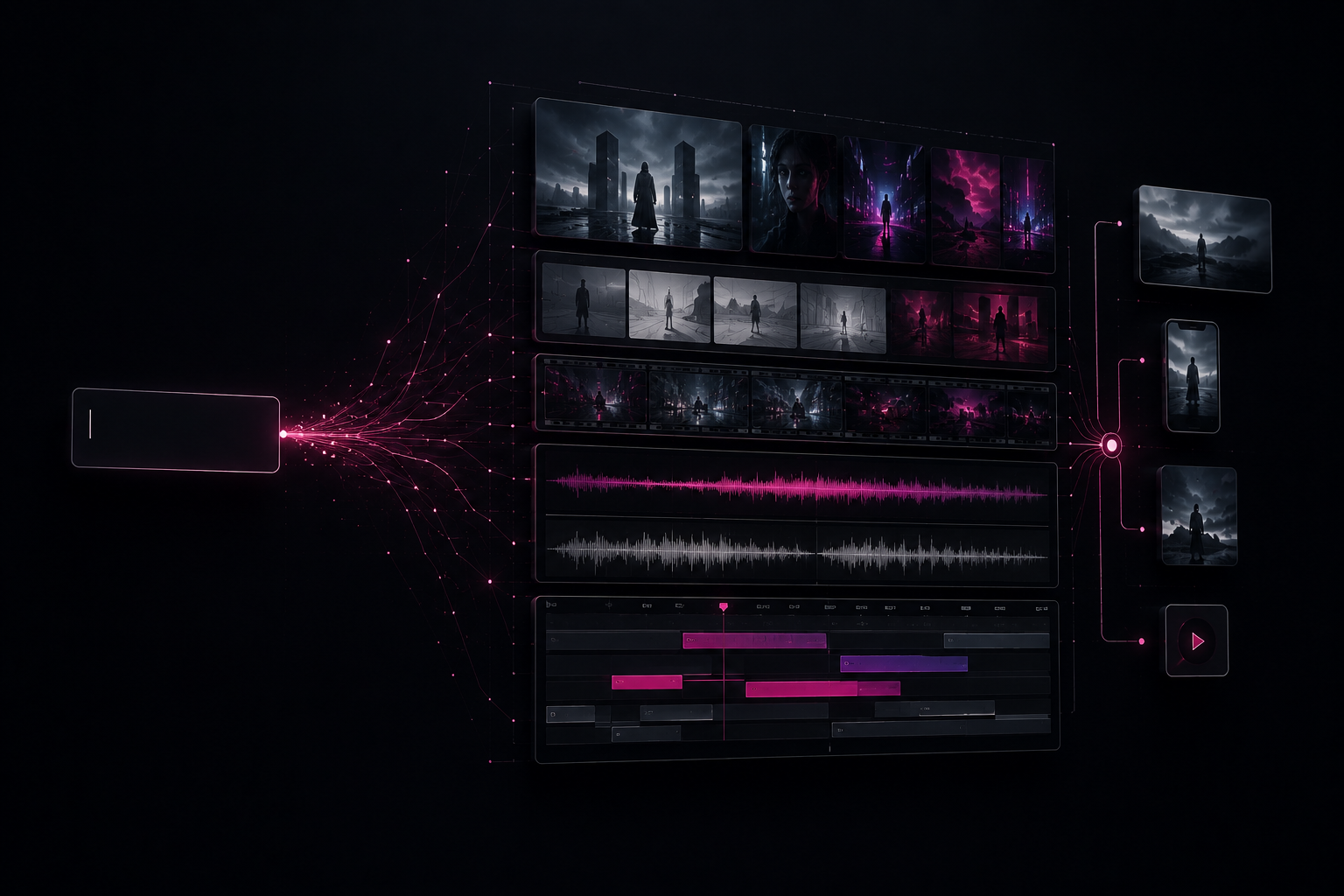
The prompt was only the beginning
The first wave of generative AI made one idea extremely powerful: type what you want, get something back.
That changed how people imagined creativity, production and content creation.
The prompt became the symbol of a new era.
But in commercial video production, the prompt is not enough.
A prompt can start a generation. It cannot replace a production system.
It can describe an image, a scene or a style. But it does not define the strategic role of the video, the brand logic behind it, the hierarchy of the message, the platform constraints, the production pipeline, the approval process or the final delivery requirements.
For brands, the future is not prompt-based production.
It is system-based production.
What a prompt can do
A prompt is useful because it compresses intention into language.
It allows a person to describe a visual direction, a mood, a camera angle, a character, a product, a world or a motion idea.
In the right hands, prompts can be powerful creative instruments.
They can accelerate exploration, help prototype ideas, generate visual references and reduce the distance between imagination and execution.
But prompts have limits.
They are local instructions. They usually operate at the level of a single output.
A brand, however, does not need one isolated output. It needs a controlled chain of decisions that can produce coherent video assets across formats, channels and objectives.
That requires more than prompting.
It requires a production system.
The problem with prompt-first production
Prompt-first production often begins with a visual idea before there is a strategic decision.
Someone writes a prompt. The tool generates a result. The team reacts. Another prompt is written. Another result appears. The process continues through trial and error.
This can be useful in experimentation. But it becomes fragile when the goal is commercial production.
Because the central question is no longer whether the image is interesting.
The question is whether the output is right for the brand, the audience, the objective, the format and the campaign context.
Prompt-first production often creates several risks:
The tool leads the creative direction instead of the brand.
Visual exploration replaces strategic decision-making.
Each output starts from zero.
Consistency becomes hard to maintain.
Approvals become subjective.
Iteration becomes chaotic.
The final result depends too much on individual prompting skill.
This is not a scalable model for brands.
It is a creative experiment, not a production workflow.
Why brands need systems, not isolated generations
Brands operate through repetition and difference.
They need to repeat enough to remain recognizable, but vary enough to stay relevant across channels, audiences and moments.
That balance is difficult.
A single prompt does not manage it.
A system can.
A system can define what should stay stable and what can change. It can preserve brand identity while adapting message, format, duration, platform, visual intensity and call to action.
For example, the same brand may need:
a 15-second social ad for paid performance;
a 30-second commercial spot for a campaign;
a 6-second avatar hook for testing;
a product video for a landing page;
a 60-second brand film for deeper storytelling.
Those pieces should not feel disconnected. They should come from the same strategic core.
That is the role of a production system.
What a production system does differently
A production system does not ask a tool to invent the whole answer.
It structures the work before execution begins.
It defines the brand, the objective, the audience, the message, the format, the creative territory, the assets, the constraints and the production logic.
Then it turns those decisions into outputs.
A serious AI video production system connects several layers:
Brand understanding The system needs to know what the brand is, how it speaks, what it sells, who it serves and what makes it different.
Strategic brief The project needs a clear objective, message hierarchy, funnel stage, platform and desired action.
Creative direction The idea needs tone, visual world, rhythm, references, emotional intention and limits.
Script and storyboard The concept needs to become a sequence of shots, actions, lines, product moments and transitions.
Production engine The approved structure needs to become video, audio, graphics, voiceover, music, packshot and final assets.
Review and delivery The process needs controlled approvals, revisions and exports.
A prompt may appear inside this system.
But it is no longer the system itself.
The shift from generation to orchestration
The future of AI video production is not only about generating media.
It is about orchestrating decisions.
Which model should be used? What should be produced by AI and what should be handled through design, editing, sound or postproduction? Which parts need human validation? Which assets need consistency locks? Which outputs need to be versioned? Which formats need adaptation?
Generation is one step.
Production is the full chain.
This distinction matters because brands do not buy prompts. They buy outcomes.
They need videos that are ready to use, aligned with their objectives and consistent with their brand.
The value is not just in creating pixels. The value is in reducing the distance between strategic intent and final deliverable.
Why this changes the economics of video
Traditional video production was shaped by scarcity.
Locations, crew, equipment, shooting days, postproduction time and coordination all created limits. Those limits affected which ideas could be produced, how many variations were possible and how fast campaigns could move.
Generative AI changes part of that equation.
But without a system, the old limits are replaced by new ones: inconsistency, lack of control, weak judgment, too many options and unclear workflows.
A production system is what allows AI to become commercially useful.
It turns creative potential into repeatable output.
It makes fixed scope more realistic. It makes faster timelines possible. It makes volume easier to manage. It makes creative decisions more explicit. It reduces the chaos of open-ended production.
In that sense, the real innovation is not only generative.
It is operational.
The HyperFake view
HyperFake is built around the move from prompt to production system.
We do not see AI video as a self-serve generator where the user is left alone with a blank input field.
We see it as a structured workflow where strategy, creative direction and AI-powered execution are connected.
The goal is to make commercial video production faster, clearer and more controllable without reducing it to generic automation.
A good system does not remove creativity.
It protects it from chaos.
It gives creative decisions a structure, so production can move faster without losing intention.
Final thought
The prompt changed how people imagine production.
But the system will change how brands actually produce.
The next stage of AI video is not just writing better prompts.
It is building better workflows, better creative logic and better production systems.
Because in commercial video, the question is not only what can be generated.
The question is what should be produced, why it matters and how reliably it can be delivered.
That is the shift from prompt to production system.